What Is a Maxi Rig, and Why Does Pipe Size Depend on It?
Ask ten people what makes one drilling rig different from another and most will point at the size of the machine. That’s part of it. But the real answer is pullback force, torque, and mud system capacity, and whether all three can handle the pipe you’re trying to install.
That’s what a maxi rig is built for. Here’s what that actually means, and why it matters before you ever get to the jobsite.
The Three Classes of HDD Rig
The trenchless industry generally groups horizontal directional drilling rigs into three classes: mini, midi, and maxi.
- Mini rigs handle smaller utility work: fiber, conduit, water service lines, the kind of bores that don’t need much pullback force to get the job done.
- Midi rigs step up from there, built for mid-size utility and municipal pipeline work.
- Maxi rigs are the top of the fleet. They’re built with the pullback force, torque, and mud system capacity to install the biggest pipe over the longest distances, through the hardest ground.
The class of rig on site sets a hard ceiling on what a crossing can do. A mini rig physically cannot pull a 42-inch transmission line under a half-mile river crossing. It’s not a question of operator skill. The equipment isn’t rated for it.
What a Maxi Rig Actually Has to Do
Large diameter HDD, 24 inches and up, asks more of a rig than smaller bores do. Three things in particular:
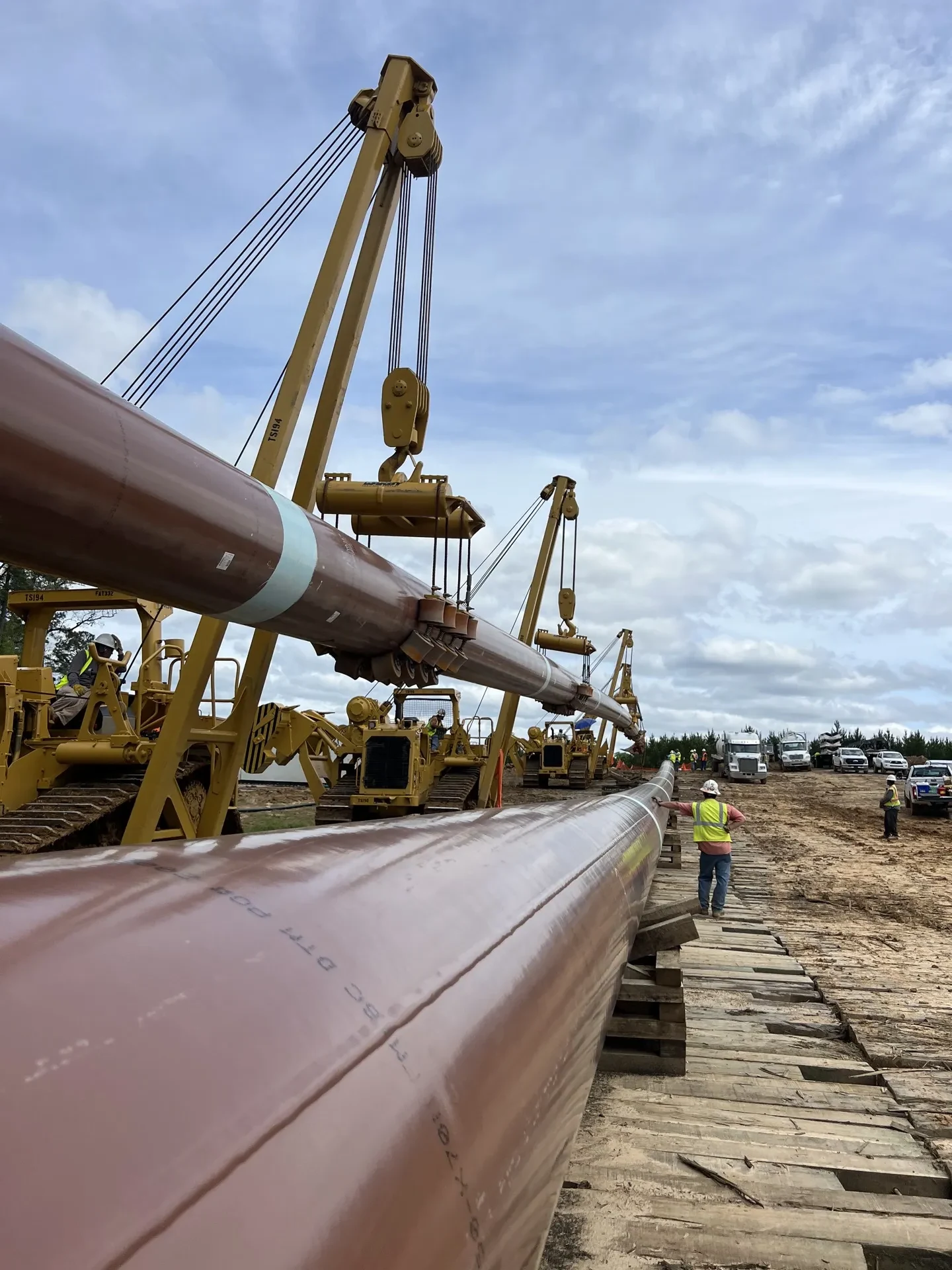
- Pullback force. As pipe diameter and crossing length go up, so does the friction and drag on the drill string. A maxi rig has to generate enough pulling power to drag heavy pipe through a fully reamed hole without stalling out partway through.
- Torque. Reaming a hole out to 56 inches means turning a large-diameter cutting tool through changing ground, sometimes clay, sometimes rock, sometimes both in the same bore. That takes torque a smaller rig simply doesn’t have.
- Mud system capacity. Bigger holes need more drilling fluid moving through them, circulating faster, to keep cuttings clear and the bore stable. Undersized mud systems are a common reason big crossings run into trouble.
Get any one of those wrong and a crossing doesn’t fail gracefully. It fails expensively, mid-pull, with pipe stuck in the ground.
The Equipment Is Only Half the Story
A maxi rig in the wrong hands is still just an expensive way to get stuck. The other half is the crew running it, and specifically the guidance engineers steering the bore.
On a large diameter crossing, guidance engineers are tracking the drill head’s position in real time, hundreds of feet down, and making the calls that keep a multi-thousand-foot bore on a path measured in inches. That’s a different skill than running the rig itself. The best guidance engineers have usually worked both sides of the operation, superintendent and downhole navigation, so they understand what the crew on the surface needs from the numbers they’re calling.
Rig class gets you into the conversation. Crew experience is what actually finishes the crossing. (For how those two things come together in the field, see The HDD Process and What Is an Intersect Bore for how the hardest version of this gets done.)
NCDD’s Maxi Rig Fleet
We run a maxi rig fleet built for exactly this work: pipe from 24 inches up to 56 inches, over the longest and hardest crossings in the business. Our leadership team brings 80+ years of combined HDD experience to it, including over 50 miles of 42-inch pipeline installed, and a 100% completion rate on every crossing we’ve taken under contract. We’ve tooled and staffed for hard rock, cobble, clay, sand, and every mixed-face condition in between.
Our large diameter work, including an intersect bore under the Roanoke Sound and a coordinated 10,000-foot intersect crossing, has been covered by Trenchless Technology, the industry’s leading trade publication, which also featured NCDD leadership in an industry analysis on the state of the maxi rig market. You can see that coverage on our media page.
Bringing the Right Rig to the Right Job
Not every project needs a maxi rig. A short utility bore doesn’t. But the moment a crossing calls for large diameter pipe, real distance, or ground that fights back, the class of equipment on site stops being a detail and starts being the whole job. Bring a rig that isn’t rated for the work and no amount of crew skill fixes that.
That’s the call we make on every project before the first pilot hole goes in: does this crossing need a maxi rig, and does it need ours.
Have a large diameter crossing you’re trying to size up? Tell us about it and we’ll tell you straight whether it’s a maxi rig job, and what it’ll take to get it done.
This article is general information, not engineering, legal, permitting, or safety advice. Every site is different, so talk to your project engineer or contact us about your project.

Eddie Ramos, SVP
North Country Directional Drilling